Fractions Rules for Grade 6: 5 Easy Examples and Practice
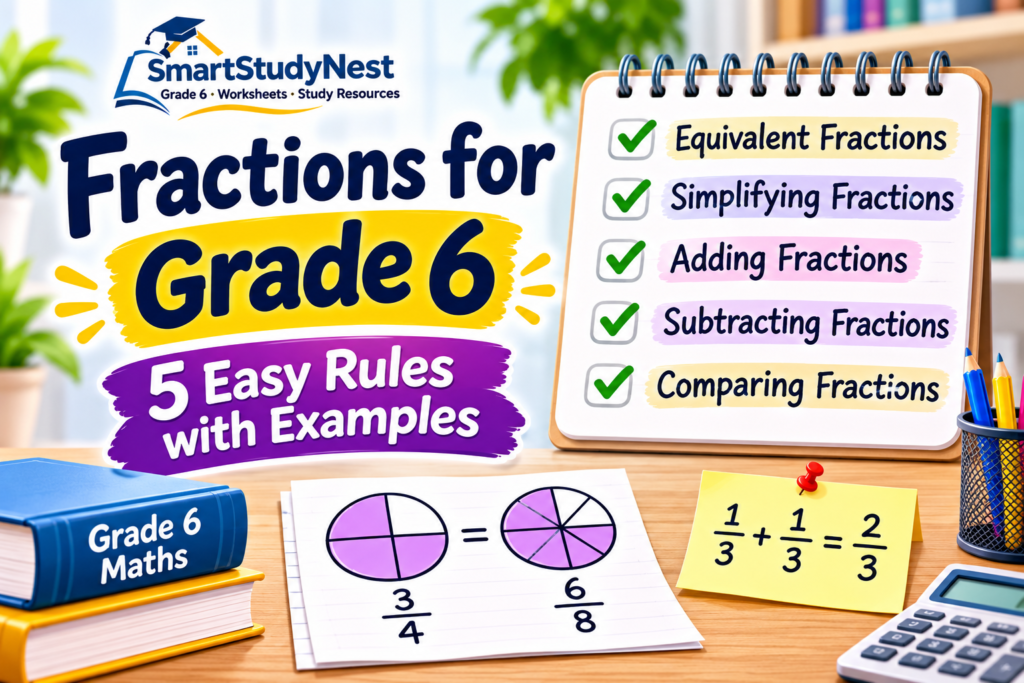
Fractions are an important part of Grade 6 Mathematics. Learning the basic fractions rules for Grade 6 helps students understand parts of a whole, compare quantities and solve everyday problems..
Learning a few simple fraction rules can make Maths much easier. In this guide, we will explore five important rules with step-by-step examples and practice questions.
1. Understanding Equivalent Fractions
Equivalent fractions have different numerators and denominators but represent the same value.
For example:
[
\frac{1}{2}=\frac{2}{4}=\frac{3}{6}
]
Rule: Multiply or divide both the numerator and denominator by the same non-zero number.
Example:
Find an equivalent fraction for 3/4.
Multiply both numbers by 2:
[
\frac{3\times2}{4\times2}=\frac{6}{8}
]
Therefore, 3/4 and 6/8 are equivalent fractions.
2. Simplifying Fractions
Simplifying means writing a fraction in its smallest possible form.
Rule: Divide the numerator and denominator by their greatest common factor (GCF).
Example:
Simplify 12/18.
The greatest common factor of 12 and 18 is 6.
[
\frac{12\div6}{18\div6}=\frac{2}{3}
]
Answer: 2/3.
Remember: Always divide the top and bottom numbers by the same number.
3. Adding Fractions
To add fractions, first check whether their denominators are the same.
When denominators are the same:
Add the numerators and keep the denominator unchanged.
Example:
[
\frac{2}{7}+\frac{3}{7}=\frac{5}{7}
]
When denominators are different:
Find a common denominator before adding.
Example:
[
\frac{1}{2}+\frac{1}{4}
]
Change 1/2 into 2/4:
[
\frac{2}{4}+\frac{1}{4}=\frac{3}{4}
]
Answer: 3/4.
4. Subtracting Fractions
Subtracting fractions follows a similar rule to addition.
Rule: Make the denominators the same, subtract the numerators and keep the common denominator.
Example:
[
\frac{5}{6}-\frac{2}{6}=\frac{3}{6}
]
Now simplify:
[
\frac{3}{6}=\frac{1}{2}
]
Answer: 1/2.
If the denominators are different, find a common denominator first.
Example:
[
\frac{3}{4}-\frac{1}{2}
]
Change 1/2 into 2/4:
[
\frac{3}{4}-\frac{2}{4}=\frac{1}{4}
]
Answer: 1/4.
5. Comparing Fractions
Comparing fractions means deciding which fraction is greater or smaller.
Rule: If the denominators are the same, compare the numerators. If they are different, convert the fractions to a common denominator.
Example:
Which is greater: 3/4 or 2/4?
Since 3 is greater than 2:
[
\frac{3}{4}>\frac{2}{4}
]
Another example:
Which is greater: 1/2 or 2/3?
Convert them to sixths:
[
\frac{1}{2}=\frac{3}{6}
]
[
\frac{2}{3}=\frac{4}{6}
]
Therefore:
[
\frac{2}{3}>\frac{1}{2}
]
Common Fraction Mistakes to Avoid
- Never add denominators when adding fractions.
- Always use a common denominator when necessary.
- Simplify your final answer whenever possible.
- Remember to multiply or divide both parts of a fraction by the same number.
- Check your calculations carefully.
Grade 6 Fractions Practice Questions
Try these questions without looking at the answers.
- Write an equivalent fraction for 2/3 by multiplying both numbers by 3.
- Simplify 8/12.
- Calculate 2/5 + 1/5.
- Calculate 5/8 − 2/8.
- Calculate 1/2 + 1/4.
- Which is greater: 3/5 or 4/5?
- Calculate 3/4 − 1/4.
- Simplify 15/20.
Answers
- 6/9
- 2/3
- 3/5
- 3/8
- 3/4
- 4/5
- 2/4 = 1/2
- 3/4
Final Tips for Grade 6 Students
Fractions become easier when you understand the rules and practise regularly.
Remember to:
- Learn your multiplication tables.
- Find common denominators before adding or subtracting different fractions.
- Simplify your answers.
- Practise a few questions every day.
For more detailed explanations, visit our Grade 6 Fractions Guide.
You can also download our free Grade 6 Maths worksheets for extra practice.
Practising these fractions rules for Grade 6 regularly will help you solve fraction problems more confidently and prepare for Maths tests.
Keep learning, keep practising and build your Maths confidence with SmartStudyNest!
📚 Need More Grade 6 Practice?
Explore our free Grade 6 Maths worksheets and printable practice resources from SmartStudyNest.
Explore Free Resources